THE 252 YOUTH HUB / PROJECT PROPOSAL
ONE ROOF. ONE COMMUNITY. ONE VISION.
A safe place to lounge, connect and grow. Start with a suitable space; build the full youth vision in phases.
Breahna Harris | Founder & Visionary
Updated October 16, 2026
EXPANDED PROJECT PROPOSAL / OCTOBER 16, 2026
Start with a safe, supervised place for teens to lounge and belong. Build gym access, transportation, and theater and arts in phases, with the city and community.
chapters covering an affordable starting space, the three core pillars, city support options, working dates and the full long-term vision.
DOWNLOAD THE FULL PDF ↗Founder & Visionary: Breahna Harris
Development proposal. No facility secured.
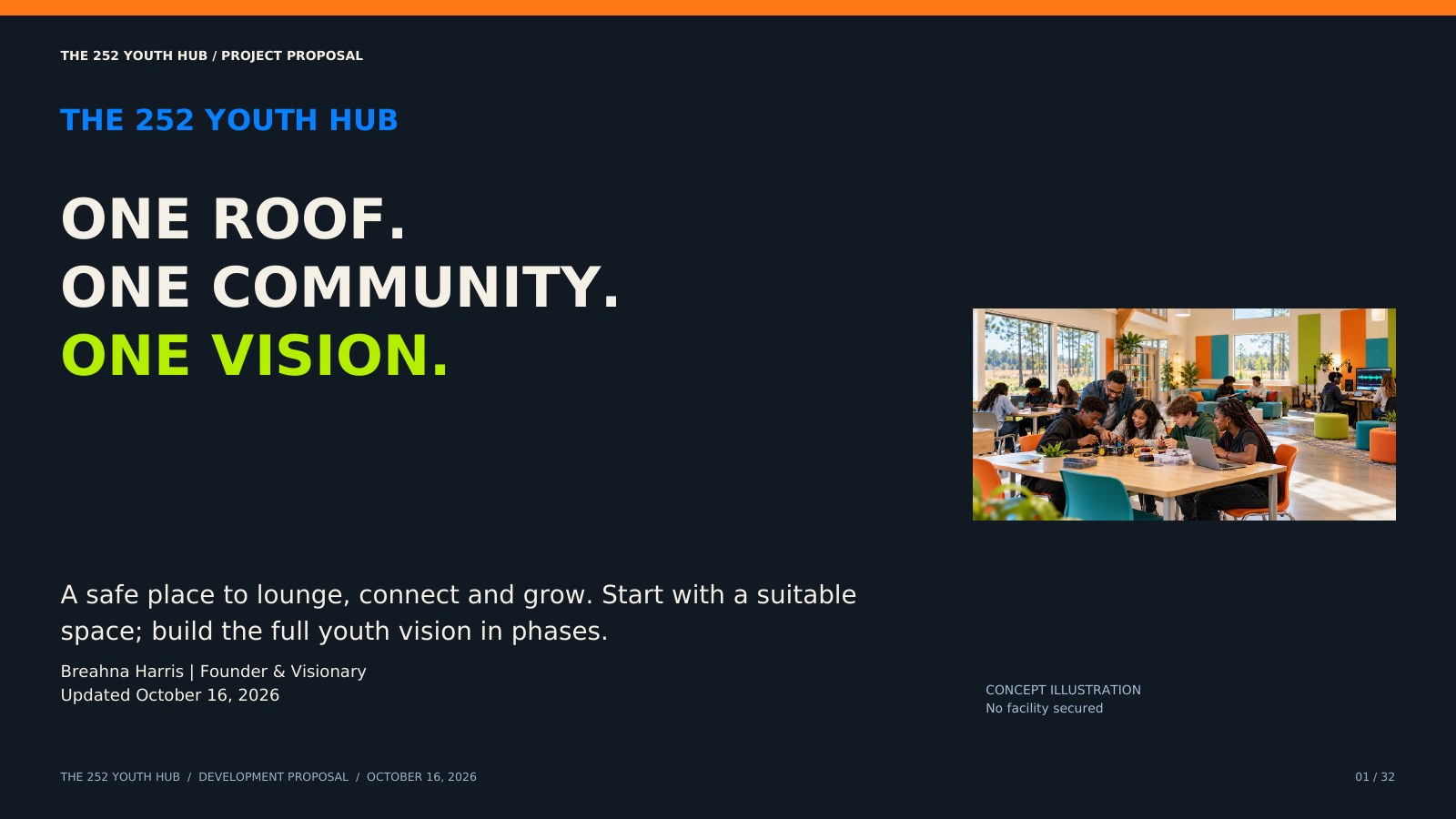
A proposed youth and community center for Eastern Carolina.
Concept images illustrate possibilities. Plans, budgets and agreements require confirmation before operations.
THE 252 YOUTH HUB / PROJECT PROPOSAL
A safe place to lounge, connect and grow. Start with a suitable space; build the full youth vision in phases.
Breahna Harris | Founder & Visionary
Updated October 16, 2026
EXECUTIVE OVERVIEW
The first priority is a welcoming, supervised teen lounge: a place to relax with friends, get homework help, join activities and connect with caring adults.
We are open to a suitable, affordable space. The former Lidl building is one possibility only; securing that property is not a condition for moving forward.
Gym access, transportation, and theater and arts are the three core program pillars. Begin through available facilities and approved partnerships, then add dedicated spaces as resources allow.
Ask the city to help identify space and develop a practical operating arrangement. City operation, a written partnership or another sustainable community model remain open for discussion.
Development stage. “Open to options” does not mean the center is open for programs. No facility or city commitment is secured.
THE PURPOSE
Belonging: offer a consistent, welcoming environment where young people feel seen and supported by caring adults.
Learning: connect academic help with technology, creative expression and practical life skills.
Opportunity: introduce trades, colleges, employers and local entrepreneurs so teens can explore possible futures.
Access: plan for participation barriers, transportation needs and practical family support. Youth access is intended without a membership-fee model.
PROPOSED PROGRAM AREAS
Arts & communication: plays, music, dance, spoken word, debate, public speaking and production skills.
Learning & mentorship: study hall, individual study spaces, dedicated tutoring, life skills and financial literacy.
STEM & media: hands-on science, technology, recording, digital storytelling and technical career exposure.
Sports & recreation: a full basketball court, supervised recreation, youth sports conversations and teen gatherings.
Culinary & enterprise: culinary instruction, entrepreneurship and a possible independently operated cafe.
Family & access: pantry, care closet, resource connections, supervised trips and transportation planning.
Program scope, scheduling and capacity will depend on the facility, staffing, funding and approvals.
FACILITY CONCEPT
A suitable existing room, shared community space or modest standalone site could provide the first home. Size should follow actual demand, safe capacity and sustainable costs.
Prioritize comfortable seating, open visibility, accessible restrooms, homework space, simple recreation and safe arrival and pickup arrangements.
A full gym and theater do not have to be inside the first location. Seek scheduled access to suitable existing spaces under approved agreements.
The larger facility remains a long-term concept. Do not make an expensive lease or construction project the prerequisite for serving youth safely.
Assess staffing, accessibility, occupancy, insurance and operating costs before choosing any space.
ACADEMICS / MENTORSHIP / STEM
Offer homework support, study strategies and focused tutoring with appropriate supervision. Help teens identify goals and ask for help with confidence.
Explore financial literacy, digital literacy and practical life skills through activities that connect learning to everyday decisions.
Invite qualified educators, tradespeople, colleges and businesses into conversations about demonstrations, career visits and future workshops.
Use hands-on STEM and digital storytelling to help young people discover interests before choosing a career path.
SIGNATURE PILLAR / PERFORMING ARTS
Begin with acting, music, dance, spoken word, visual arts and storytelling workshops in suitable approved spaces.
Explore rehearsal and performance access through schools, theaters and other willing venue operators. No venue or partnership is confirmed.
Grow toward a dedicated multipurpose theater and stage, with sound, lighting, backstage learning and community productions when feasible.
A stage remains part of the full vision. A dedicated theater is a growth goal, not a requirement for the first teen lounge.
ARTS PATHWAYS / EVERY KIND OF CREATIVE TALENT
On stage: acting, improvisation, musical performance, dance, spoken word and public speaking.
Behind the scenes: sound, lighting, stage management, costumes, set design, event production and arts administration.
In the studio: visual art, photography, film, podcasting, recording and digital storytelling.
Build confidence through guided practice, collaboration and youth showcases. Provide pathways for beginners as well as experienced performers.
PROPOSED ARTS PROGRAM / ACCESS FIRST
Offer introductory workshops, rehearsal groups, a youth production pathway and opportunities to exhibit or perform throughout the year.
Invite teaching artists, theater organizations, schools and community creatives into planning. RiverTowne Players is an outreach conversation, not a confirmed operating partner.
Plan supplies, instruments, costumes, accessible participation and transportation support so limited household resources do not determine who can take part.
Track participation, returning learners, creative portfolios and youth feedback. Set capacity and schedules only after staffing and costs are confirmed.
The goal is affordable, welcoming youth access without a membership-fee barrier. Funding and final policy must support that goal.
GYM / RECREATION / YOUTH TEAMS
Connect teens with supervised basketball, recreation, teamwork and positive coaching through suitable existing gyms where access can be agreed.
Explore AAU and other youth sports opportunities, including conversations with Team T.R.I.B.E. Help families identify participation resources when available.
Grow toward a dedicated full-court Hub gym if future space and funding support it. Preserve study, arts and lounge activities alongside sports.
No gym schedule, team placement, scholarship or operating partnership is confirmed.
ACCESS / CONNECT YOUTH TO OPPORTUNITY
Help young people reach the lounge, gym activities, arts experiences and educational trips when families face transportation barriers.
Compare practical first steps: family pickup arrangements, approved transport partners or a Hub passenger vehicle when affordable.
A bus or passenger van is a future option, not a confirmed purchase. Budget for drivers, insurance, maintenance, fuel, accessibility and safe operating procedures.
Routes, trips and vehicle use require qualified oversight and appropriate permissions before any service begins.
Transportation is central to access, but no ride service, route or vehicle is currently available.
PRACTICAL SKILLS / SMALL-BUSINESS OPPORTUNITY
The culinary vision includes food-safety learning, preparation skills and career exposure with qualified instructors. A teaching-kitchen expansion needs its own design, equipment estimates and operating plan.
Heather Lester Vargas has expressed interest in exploring her coffee cafe inside the future center. This is a proposed opportunity, with no confirmed business tenancy or opening date.
An independent cafe could complement the youth environment, support its own business expenses and contribute toward shared costs through an agreed arrangement.
Heather’s official cafe name, menu, pricing and contact information await her confirmation.
FAMILY SUPPORT / TRANSPORTATION
Develop a pantry and care closet around useful food choices, clean clothing, school supplies and hygiene essentials. Coordinate donations and safe storage before collection begins.
Connect families with qualified support providers and maintain privacy and dignity in requests for help.
Plan a suitable transportation option for approved trips, colleges, career opportunities and activities. Inspection, insurance, maintenance, consent and qualified drivers must precede service.
ONE ROOF / COMPLEMENTARY SOURCES OF SUPPORT
The first phase does not require a mini-mall layout, private tenants or rental income. Start with the youth lounge and a sustainable staffing and operating plan.
Over time, consider a cafe, culinary space, gym use and theater rentals where they fit the facility, youth schedule and operating model.
Potential business contributions may support costs under written terms. They are optional future opportunities, not committed income or a substitute for a funded budget.
The goal is shared support for a youth-centered community home. The model still needs feasibility testing.
COST ALLOCATION / STEWARDSHIP
Under a city-operated model, the city would determine budgeting, revenue collection, purchasing and department cost allocation. Hub income would not be privately controlled.
Under a separate nonprofit partnership, use written operating and facility agreements. Track direct costs and any agreed contribution toward shared expenses.
Compare net amounts available for shared costs with the full monthly budget. Gross sales are not the same as a contribution available to pay building expenses.
Respect restrictions on gifts and sponsorships. Review cash timing, vacancies, reserves, staffing and responsibilities before commitments.
Potential income does not establish affordability. The formal startup and operating budgets remain in development.
CURRENT EXPLORATION / FORMER LIDL PROPERTY
Compare available public, donated, shared, sponsored or affordable leased space. Start small if that provides a safe, supervised home sooner and within reliable resources.
The former Lidl at 553 US-70 W is only one explored option. It is not required, selected or secured. Prior broker figures were about $585,000 annual base rent before NNN expenses; that is not the Hub’s minimum budget.
Request actual costs for each viable option: occupancy, improvements, utilities, insurance, staffing, supplies, maintenance and access support.
Prefer manageable commitments and a realistic reserve. A smaller pilot should be considered before a large long-term obligation.
Property selection follows feasibility. No lease, acquisition, location or operating budget is committed.
MILESTONES / NOT A COMPLETE PROJECT BUDGET
First develop a right-sized teen-lounge startup and operating budget. Identify how many days, youth places and supervised activities can be reliably funded.
The existing $100,000 building campaign is a first-phase fundraising milestone, not a required lease, purchase price or complete opening budget.
The separate $25,000 transportation and $25,000 theater targets remain draft planning goals. Neither is a verified vehicle, buildout or annual operating cost.
Gym access needs its own estimate: facility use, supervision, equipment and any participation support. Dedicated construction would require a separate capital plan.
Revise campaign allocations transparently as the actual space and operating model are selected. Honor restrictions on gifts.
THE REQUEST / A PUBLIC YOUTH & ARTS HOME
1. Help identify a safe, suitable, affordable space for a supervised teen lounge. Consider existing city or shared community facilities before a large property commitment.
2. Work with us on a practical staffing and operating plan: supervision, utilities, insurance, maintenance, supplies and accessible youth participation.
3. Explore access to existing gyms and arts or performance spaces, plus a safe transportation pathway. These remain the three core program pillars.
4. Designate a staff contact and review city operation or a written partnership. Agree on a feasibility process and return with costs and options for consideration.
We are requesting a practical starting place and a sustainable path to grow, not a commitment to acquire Lidl.
AN OPTION FOR DISCUSSION / NOT A REQUIRED STRUCTURE
One option is a youth program or center within Parks & Recreation. The city would decide whether this fits its services, structure and budget. A written partnership remains another option.
City leadership would control the approved budget, staff supervision, facility operations and public policies. Community members and young people could inform an approved advisory process.
Breahna would bring the founding vision, community relationships and program concept to planning. Any paid position or contract would require the city’s own approval and hiring or selection process.
The Hub is currently an independent initiative. Becoming municipal requires a deliberate agreement; the nonprofit, brand, funds and obligations do not transfer automatically.
Proposed governance only. Havelock has not adopted the Hub or offered a position.
CITY DISCUSSION / OPEN TO A VIABLE MODEL
City-operated center: municipal leadership, city-approved staffing and budget, with community programming input. This is an option to evaluate rather than a required outcome.
City facility + nonprofit operator: city controls the property; a qualified organization delivers services under a reviewed written agreement and reporting requirements.
Independent Hub + city support: the Hub retains operations while seeking defined facility access, coordination or other authorized support. This is not a city department.
Compare full cost, accountability, funding eligibility, youth access and risk before selecting a model. The City Manager and city attorney should guide the review.
No operating structure, public subsidy or private tenancy has been approved.
WHAT CITY SUPPORT WOULD NEED TO COVER
Space: assess a modest lounge, shared use or available building, with safe capacity, restrooms, visibility and accessible arrival.
People: establish who supervises youth, who manages daily activities and how staffing, screening and training will be supported.
Operating costs: price the actual hours and program scope before seeking a defined contribution or budget appropriation.
Access and growth: evaluate gym and theater access, transportation and future expansion separately so the first phase remains affordable.
No city funding amount is assumed. Seek costed options, documented commitments and clear responsibilities.
PARTNERSHIPS / CLEAR PUBLIC RESPONSIBILITIES
Use youth and family listening sessions to test demand and identify missing arts, learning and recreation opportunities. Coordinate with existing city services.
Invite artists, educators, coaches, employers and local businesses to propose defined contributions. Inclusion in this proposal does not establish a contract or endorsement.
Heather’s cafe and other private operators remain concepts. Any use of city space needs city review of allowable uses, operator selection, written terms and separation of public and business money.
A city-operated program would be welcoming to all and follow city policies. Optional outside faith-based activities would need separate review rather than being presumed part of public programming.
FEASIBILITY WORK PLAN / SUBJECT TO CITY AGREEMENT
Days 1-30: meet with city staff; agree on the question to study; gather youth and arts input; identify potential sites and existing program connections.
Days 31-60: compare properties, theater needs, startup costs, annual operations, staffing and possible funding sources. Review the governance options.
Days 61-90: prepare an options report and recommended next step for city consideration, including a smaller pilot if a full facility is not yet affordable.
After a decision: secure written authority, funding, facility readiness and required policies before opening. This review period is a request, not an approved schedule.
PROPOSED MEETING LANGUAGE / NOT AN ADOPTED MOTION
“Can the City of Havelock help us identify a safe, affordable place for a supervised teen lounge and work with us on a sustainable operating plan?”
“We are open to a city program, a written partnership or another viable arrangement. Lidl is not a requirement.”
“We would like to explore access to existing gyms and theater or arts spaces, plus transportation, while growing the full Hub vision in phases.”
First seek a staff planning conversation and feasibility review. Property, staffing and spending decisions follow the review.
SMALL BUSINESSES / COMMUNITY TALENT
Explore suitable space for local operators whose business fits the property and the youth-centered environment. Confirm landlord permission, permitted uses and written terms.
Connect entrepreneurs and skilled professionals with possible youth learning opportunities, such as customer service, hospitality, media, trades or business planning.
As funding and operations develop, assess staffing, contracted services and training needs. No jobs, wages, internships or employment placements are committed at this stage.
GOVERNANCE / SAFETY / OPERATIONS
Confirm the operating model first. City operation would use municipal governance, finance and policies. A separate nonprofit model would need its own authorized governance, banking, bookkeeping and insurance.
Prepare youth protection procedures, screening, supervision, consent, emergency response, incident reporting and transportation policies.
Define public access, partner boundaries, food-service responsibilities and the safe use of shared spaces.
State incorporation approval was last reported pending. IRS 501(c)(3) recognition has not been received. Do not represent gifts as tax-deductible or publish check instructions before organizational banking is confirmed.
Funding, qualified people, policies and required permissions must precede program operations.
READINESS GATES / NO PROMISED OPENING DATE
Phase 1: listen to youth and families, identify available spaces and develop the minimum safe teen-lounge operating scope.
Phase 2: agree on responsibilities, secure reliable funding and permissions, and prepare supervision, policies and facilities.
Phase 3: open a limited lounge and activity program only when ready. Use approved external spaces for gym and arts activities where available.
Phase 4: evaluate demand, participation and cost. Expand transportation and dedicated facilities when resources support the next step.
A readiness-based plan. No location, public opening or launch date is confirmed.
PLANNING TARGETS / SUBJECT TO READINESS
October-December 2026: meet with city leaders and community members, gather youth input, tour possible spaces and identify program collaborators.
January-March 2027: seek an agreed feasibility review, compare operating models, and build startup and annual budgets. City participation is not yet confirmed.
April-June 2027: seek written commitments and consider small activities in approved existing venues if funding and supervision are ready.
July-September 2027: prepare a selected space and program scope if secured. Fall 2027 is a working goal for phased opening, not a deadline or announcement.
A safe smaller pilot could come earlier; a permanent center could take longer. Do not rush readiness to meet a date.
BREAHNA HARRIS / CONTINUING INVOLVEMENT
Breahna seeks an active role in planning and implementation, bringing the founding vision, educator perspective and community relationships.
Proposed planning contribution: gather youth and family input, develop program ideas, coordinate outreach and help connect partners with agreed next steps.
Her intention is to remain involved as the Hub grows. Any formal advisory, volunteer, contracted or employed role must be defined with the selected operator.
If the city operates the Hub, a paid position or contract would require its separate approval and hiring or selection process. No appointment is promised.
“There is no rush. I want to help bring this vision to life and remain part of serving our youth.”
PROPOSED MEASURES / NO RESULTS CLAIMED
Track participation and repeat visits in ways that protect privacy and follow appropriate consent practices.
Review creative portfolios, productions, workshops and youth reflections alongside academic and practical learning goals. Measure engagement without promising educational or crime outcomes.
Review mentoring participation, partner activity and whether families can access programs without avoidable barriers.
Compare actual department income and expenses with budget, funding restrictions and shared-cost agreements.
Set realistic targets after baseline information and operating capacity are established. Publish useful updates without exposing private youth information.
This proposal describes intended benefits. It does not claim measured reductions in crime or guaranteed educational outcomes.
PUBLIC FRAMEWORK / VERIFIED OCTOBER 16, 2026
Havelock Parks & Recreation describes cultural and active recreation within its mission, existing youth activities and a channel for program ideas. The Hub is proposed as a coordinated expansion, not an existing city service. havelocknc.us/160/Parks-Recreation
N.C. G.S. 160A-353 authorizes municipal recreation facilities and related funding. G.S. 160A-354 provides for departmental or commission administration. These general powers do not approve this specific project. ncleg.gov (Chapter 160A, Article 18)
City staff and counsel must evaluate the actual authority, agreements, finances, property terms and process. No commitment is attributed to any official, committee or organization.
Property figures and funding goals elsewhere are preliminary planning information. No property, city adoption, opening date or operating budget is secured.
NEXT STEPS / CONNECT WITH THE FOUNDER
Property owners: share a viable building, land opportunity or sponsored-property lead.
Businesses and donors: discuss a documented contribution, useful equipment, professional expertise or a compatible space concept.
Educators, coaches and creatives: explore future learning and mentoring conversations.
City and community leaders: meet with Breahna to review feasibility and the path toward a sustainable youth home.
Breahna Harris | Founder & Visionary
(252) 422-0454 | the252youthhub.com
LET’S DEVELOP THE NEXT CHAPTER
Broker figures reflect information supplied to the founder and need current written confirmation. Potential income is uncommitted. State incorporation approval was last reported pending and IRS 501(c)(3) recognition has not been received. Gifts are not represented as tax-deductible.